And what conscious leaders can do instead
Most senior leaders sense it: the tools that built past success are no longer sufficient. Markets are volatile, institutions are strained, and leaders must make high-stakes decisions in conditions of sustained uncertainty.
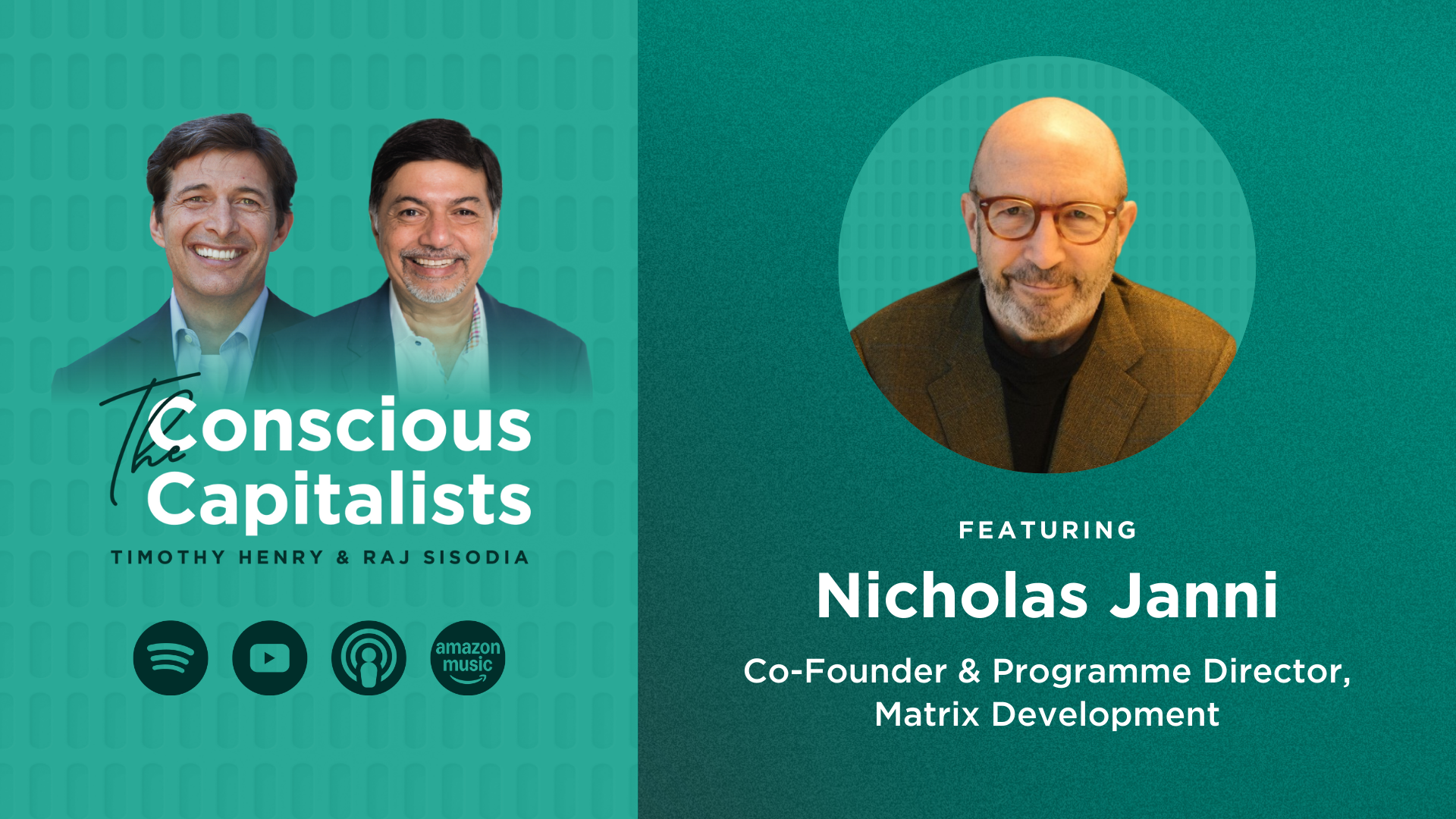
On a recent episode of The Conscious Capitalists, executive coach and author Nicholas Janni joined Raj Sisodia and Timothy Henry to explore what leadership needs to become in this new context. The conversation challenges standard approaches to leadership development and reframes what true executive capacity looks like.
Here are key takeaways from the conversation on how leaders can build the internal presence and relational strength that today’s environment demands:
1. Reconnect with the body to sharpen perception
The fastest way to improve decision quality is through presence.
Most leaders are living “neck-up,” disconnected from their physical selves. But the body is a critical source of data: it holds stress signals, intuitive insights, and the energy to sustain focused attention. Even one minute of conscious breathing before a meeting can help a leader drop into a state of grounded awareness.
Try this: pause, exhale fully, and notice your contact with the chair beneath you. This small act recalibrates attention and makes room for deeper listening and clearer thinking.
2. Make space for emotional truth
In many corporate cultures, emotions are treated as irrelevant and sometimes even dangerous. But unacknowledged emotion doesn’t disappear. It distorts team dynamics, narrows critical thinking, and erodes trust.
Great leaders build what Janni calls “radical inclusion”: the capacity to fully feel what’s happening without judgment. That includes fear, anxiety, sadness, or even boredom. When teams normalize the inclusion of feeling states (without analysis or overexposure), collaboration improves and conflict becomes less personal.
3. Build inner work into leadership development
As Janni notes, most leadership development programs remain heavily cognitive. They focus on behavior, communication, and strategy, but neglect the inner terrain that shapes those actions.
Forward-thinking companies are starting to reimagine leadership development to include body awareness, emotional literacy, and even trauma-informed practices. These aren’t luxuries. They’re the foundations of resilient, relational leadership.
If you’re responsible for talent or culture, ask yourself: are we developing the whole leader or just the skillset?
4. Shift from control to coherence
Ultimately, the leader’s job is not to control everything, it’s to create coherence: in themselves, their teams, and their organizations. That requires slowing down internally, even when the pace outside is accelerating.
Presence isn’t about doing less. It’s about doing what matters, with clarity and alignment.
A new frontier of leadership
The C-suite is being called to a different kind of leadership, one that fuses critical thinking with emotional clarity, strategic vision with embodied presence.
This is a hard requirement for navigating the complexity of our time.
You can listen to the full conversation with Nicholas Janni on The Conscious Capitalists podcast here ->