Most companies don’t drift because of bad intent. They drift because leadership teams make decisions and operate with assumptions that feel reasonable in the moment but don’t hold up over time.
Those decisions shape how the people of the organization show up, perform, and respond under pressure. And that’s where the real impact sits.
Each choice, taken on its own, can be justified. Each approach can be defended. But over time, those decisions begin to compound through the organization. What looked sensible in isolation starts to weaken capability and reduce the company’s ability to adapt.
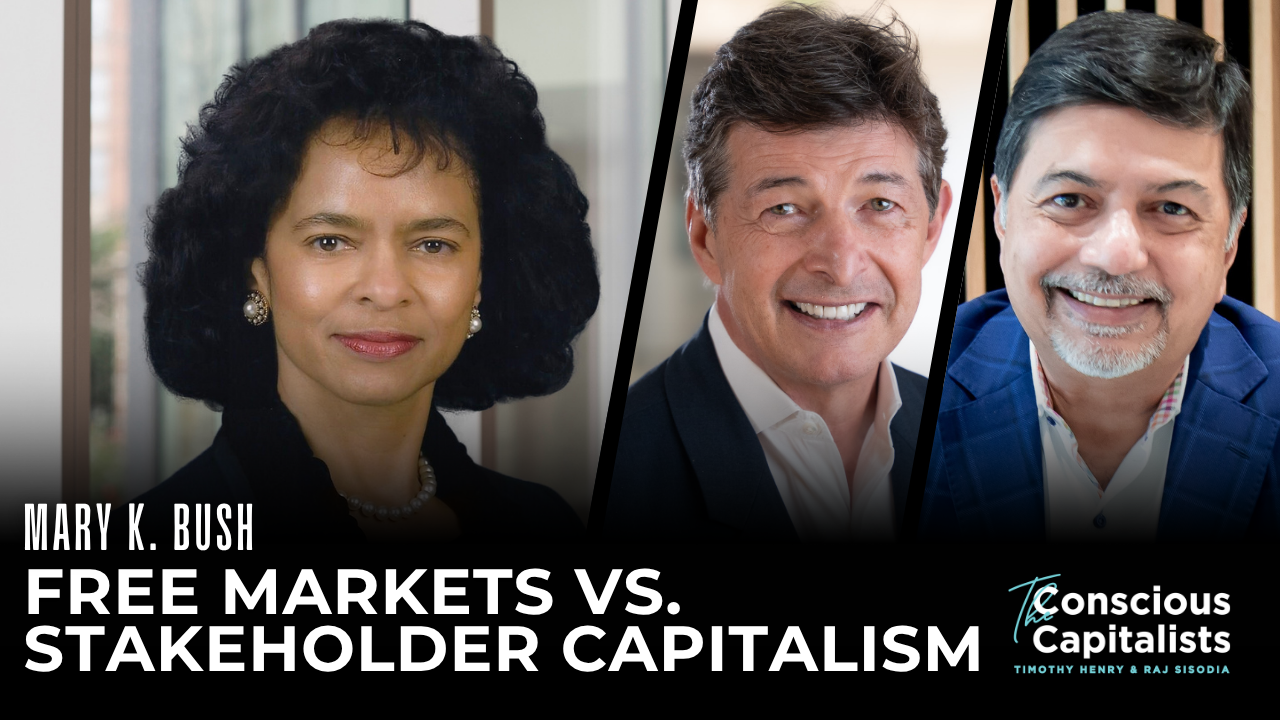
In a recent episode of The Conscious Capitalists, Timothy Henry and Raj Sisodia sit down with Mary K. Bush, President of Bush International, and unpack a more grounded way of thinking about how companies actually perform.
Here are five practical ideas from their conversation that are worth carrying into the boardroom.
1. Decisions don’t fail in isolation, they fail in accumulation.
Most leadership teams are disciplined about evaluating individual decisions. Fewer are disciplined about understanding how those decisions interact over time.
A cost reduction can improve margins and still weaken execution months later. A tougher stance with suppliers can produce savings and reduce flexibility when conditions shift. Holding back on hiring can protect short-term performance while quietly slowing the business.
None of these are poor decisions on their own. The problem shows up in how they compound.
Leaders who build durable companies develop the habit of tracing consequences beyond the immediate result. They look at how one move affects talent, trust, capability, and resilience. That level of thinking is what separates short-term optimization from long-term performance.
2. Companies should see themselves as capabilities
During the early days of the pandemic, a local government had ventilators it couldn’t get to work. Instead of turning to a medical manufacturer, they called a CEO whose company had no connection to healthcare but did have strong engineering talent.
Within a day, the team had the machines up and running.
What stands out here is not speed. It’s how the company understood itself.
Most organizations define themselves by their products or industry. That definition becomes a constraint. It limits where talent is applied and how problems are approached.
In this case, leadership saw something else. They saw a pool of engineering capability that could be redirected to solve a completely different problem. That shift made the response possible.
This is what separates companies that operate within a model from those that operate from capability. When pressure hits, the latter have more room to move.
3. You can’t build a high-performing company from a narrow talent funnel
Many companies assume they are getting the best people simply because they run a rigorous hiring process. The harder question is whether the right people ever had a chance to be in that process to begin with.
The distinction that matters here is between opportunity and access. Opportunity may exist in theory, but access to it is uneven in practice.
Companies that recognize this invest in talent earlier, widening entry points, and creating real pathways into leadership roles. When you improve the range and depth of talent inside the company, performance follows.
4. The shortest path to performance runs through your people
There’s a line that has been repeated often, but rarely taken seriously enough:
“If we take care of our employees, they will take care of the customers.”
It sounds simple. It is not. Most companies still treat people as a cost line that needs to be managed carefully, and down the line, that leads to employee disengagement.
When people don’t feel valued, they don’t give discretionary effort. Over time, that shows up in revenue, even if it doesn’t appear that way at first.
5. Leadership is revealed in what you choose to confront
During a period of civil unrest, one CEO brought together a group of young Black men in his company and asked them what they were experiencing. The conversation quickly moved beyond work. What surfaced was the reality they were dealing with simply to show up each day.
He didn’t try to resolve it on the spot. What he did instead was ensure that it was understood at the leadership level. That distinction matters. If people are carrying that kind of weight, it affects how they show up, how they perform, and how they engage with the business, whether it is acknowledged or not.
Leadership is not about always having a response ready. It’s about choosing to have the tough conversations and making your people feel seen.
None of these ideas are complicated on their own. The difficulty is in applying them consistently when decisions are being made in real time.
The companies that hold up over time tend to work through that difficulty. They think beyond the immediate outcome, they understand what their organization is truly capable of, and they invest in the people and conditions that make performance possible.
If you want to hear how these ideas come through in practice, listen to this episode of The Conscious Capitalists with Timothy Henry, Raj Sisodia, and Mary K. Bush.