Most leaders don’t struggle with accountability as a concept. They’ve spent years being measured against targets, delivering results, and taking ownership when things go wrong.
What’s changed is something more subtle, and more difficult to navigate: who they’re accountable to, and how those expectations are shifting at the same time.
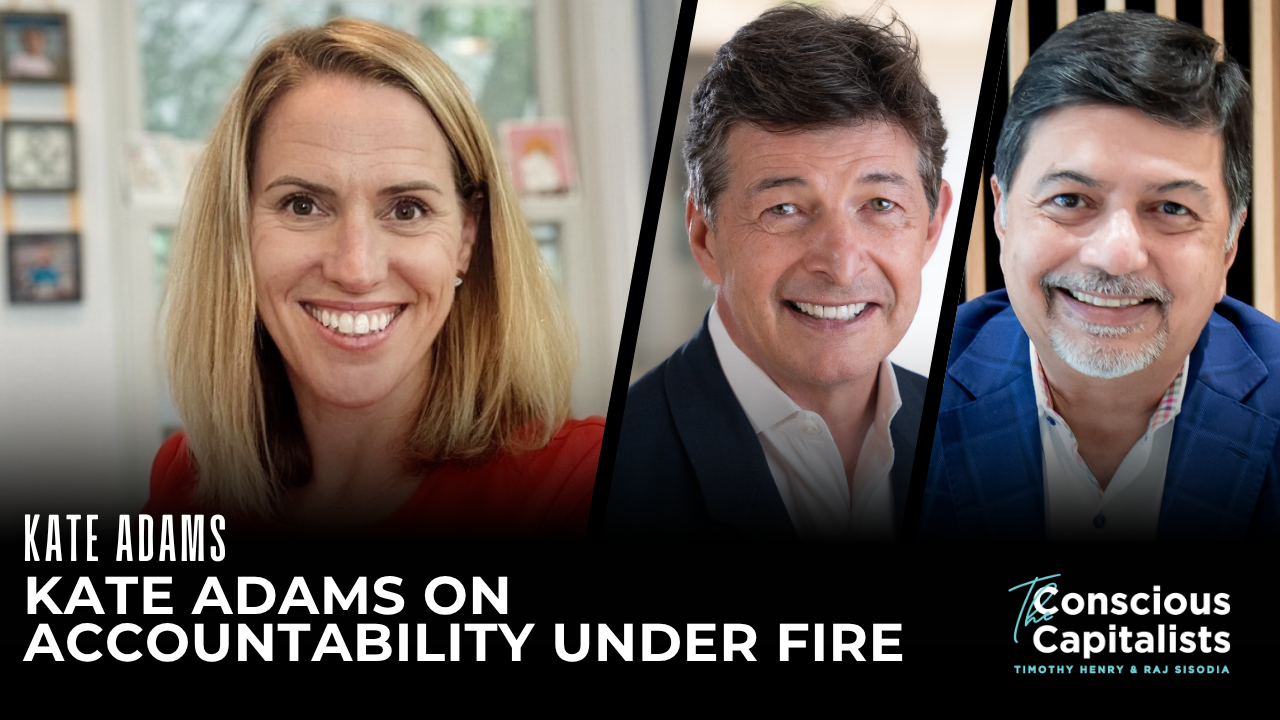
In a recent episode of The Conscious Capitalists, Kate Adams, Chief Impact Officer at Conscious Capitalism, explored this shift, drawing from her book Accountability Under Fire. It’s a conversation we’re particularly proud of because it reflects something we’ve been thinking about more deeply across our work: what accountability actually demands of leaders today.
If you’re navigating this in your own organisation, here are a few takeaways.
1. Accountability shows up when things don’t go to plan
Most organisations are usually well-structured. But when something breaks, the conversation changes quickly. It stops being about who owned the task and becomes about who was accountable for the outcome.
That’s where the role of leadership sharpens. When trust is tested, people look for clarity, and that clarity is expected to come from the top. Leaders who recognise this early tend to navigate those moments with more conviction.
2. Trade-offs are part of the job
There’s been a long-standing belief that most decisions can be structured in a way that works for everyone. In reality, many leaders are dealing with situations where expectations pull in different directions, and something has to give.
The real work is being clear about where you draw the line, and why. That clarity matters more than trying to maintain the appearance of alignment. Most leaders already know this. The challenge is being comfortable acting on it.
3. Accountability shapes what the business becomes over time
Accountability often gets framed around values or reputation. What’s becoming more apparent is how directly it influences long-term performance. The decisions leaders make under pressure, especially the ones that aren’t immediately visible, tend to define the strength of the business later on.
These decisions don’t feel dramatic at the moment, but they stack up. A year or two down the line, they’re the difference between a company that’s steady under pressure and one that’s constantly catching up.
Accountability hasn’t become more important so much as it has become harder to define. The structures that once made it clearer don’t fully hold anymore, and expectations continue to evolve.
For most leaders, the real shift is this: being more precise about what they’re accountable for, especially when the answer isn’t obvious.
That’s the conversation we’re trying to move forward.
Listen to the full episode with Kate Adams on The Conscious Capitalists →