Most leaders don’t struggle with the idea of employee ownership. They already believe in empowering teams, building strong cultures, and aligning incentives over the long term.
What’s less clear is what happens when ownership moves beyond an abstract culture code and into a solid structure or reality for the organization.
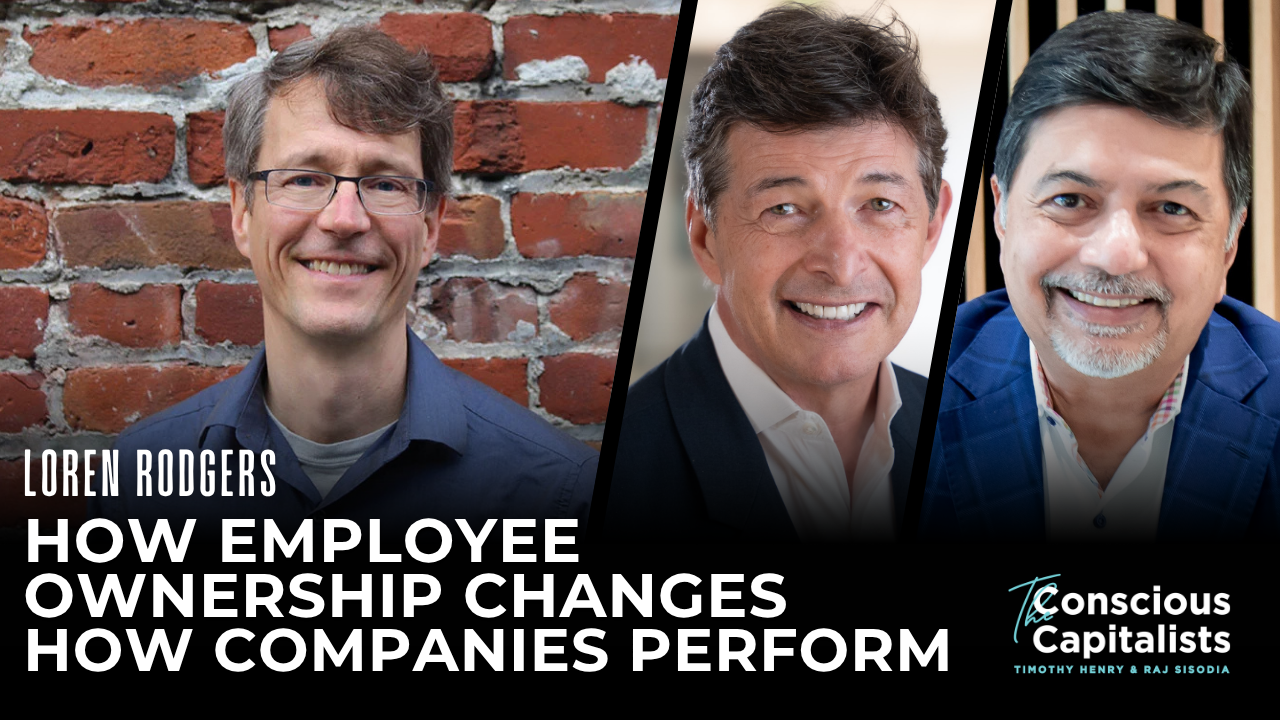
In a recent episode of The Conscious Capitalists, Loren Rodgers, Executive Director of the National Center for Employee Ownership, joined Timothy Henry and Raj Sisodia to explore what shifts when employees have a real stake in the business. It’s a conversation that raises an important question for leaders already doing the work: where does culture end and structure begin?
If you’re thinking about this in your own organization, here are a few takeaways.
- Culture scales differently when ownership is real
Most organizations already invest heavily in culture. But it behaves differently when people have something tangible at stake. Accountability is no longer abstract. It is tied directly to outcomes that employees share in.
That changes how decisions are made. It also changes how seriously people take the business itself.
For leaders, this raises a practical question. If ownership remains symbolic, how far can culture really go?
- Governance becomes an operating advantage
There is a persistent belief that employee ownership complicates governance. More stakeholders, more voices, more friction.
In practice, the opposite often happens.
Employee-owned companies are required to be more disciplined. They build clearer strategic plans, more robust projections, and more structured decision-making processes. Not as a philosophical choice, but because the system demands it.
Over time, that discipline compounds. It reduces the likelihood of avoidable mistakes and creates a stronger foundation for long-term performance.
- Productivity is a system outcome, not an effort problem
The conversation around performance often defaults to effort. How do we get people to care more, work harder, stay engaged?
What the data on employee ownership suggests is that productivity is less about individual effort and more about system design.
When employees understand the business, have visibility into how it performs, and share in the outcomes, productivity increases meaningfully and in ways that compound over time.
This shifts the focus for leadership. Instead of asking how to motivate people, the question becomes how to design a system where motivation is a natural byproduct.
- Leadership becomes a capability that has to be built
One of the less obvious implications of employee ownership is what it demands from leaders.
In a more traditional structure, leadership can rely on hierarchy and control. In an ownership-driven model, that breaks down quickly. Authority is more distributed, expectations are higher, and decisions require a different level of transparency.
The organizations that do this well invest heavily in building leaders at every level.
- The real question is not whether it works, but who it works for
There is enough data now to support the performance case for employee ownership. Higher productivity, lower turnover, stronger resilience.
The more interesting question is who benefits from that performance.
As conversations around inequality, AI, and the future of work intensify, this becomes harder to ignore. The structure of ownership determines how value is distributed. And in most cases, that distribution remains highly concentrated.
Employee ownership is one way of addressing that, not by redistributing after the fact, but by designing the system differently from the start.
For leaders operating consciously, this is where the conversation becomes more complex. It is no longer just about how the business performs, but how its success is shared.
Employee ownership is not a simple shift. It introduces new complexities, new responsibilities, and new expectations.
But it also surfaces something that many leaders are already grappling with. Culture, incentives, and performance are not separate conversations. They are tightly connected.
The question is how far you are willing to go in aligning them.
If you’d like to dive deeper into Employee Ownership, listen to the full podcast episode here ->