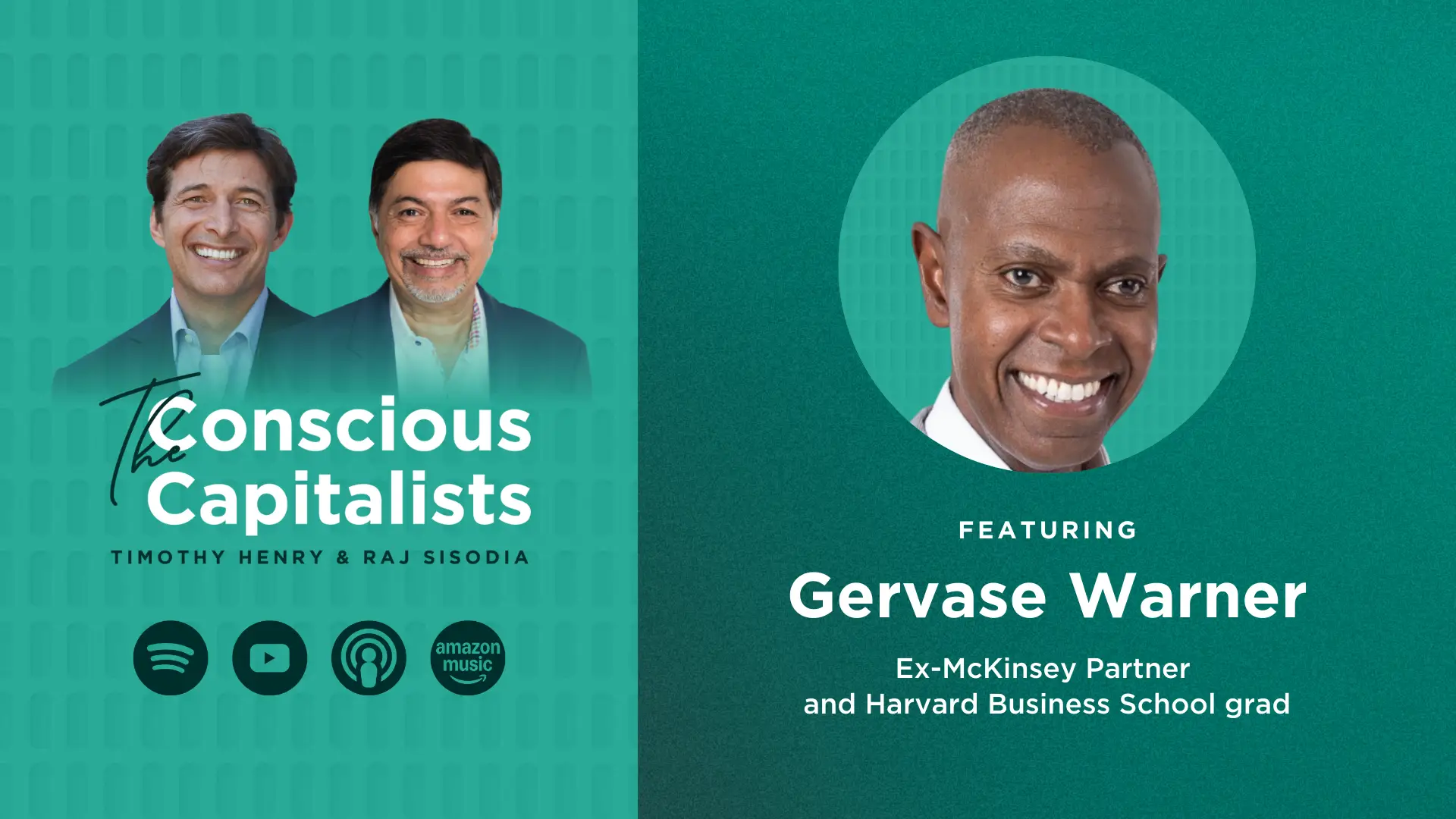
[Introduction] Tech Sounds: Tech Sounds presents The Conscious Capitalists. Hello and welcome to The Conscious Capitalists, hosted by two of the co-founders of the conscious capitalism movement and co-authors of the Conscious Capitalism Field Guide from Harvard Business Press, Raj Sisodia and Timothy Henry. For more information and notes from the show, go to www.theconsciouscapitalists.com.
Timothy Henry: Hello everyone and welcome to this episode of The Conscious Capitalists with myself, Timothy Henry, and my partner in making the world a better place through business, Raj Sisodia. Today we get into a deep conversation with Gervase Warner, the CEO of Massy, the largest business in the Caribbean basin. This first part is the story of how Gervase took Massy on the conscious capitalism journey—a look into how a former McKinsey partner and Harvard Business School grad takes a Caribbean business on that path.
Raj Sisodia: It’s my pleasure to welcome Gervase Warner to our podcast. He is the leader of the Massy Group, a diversified conglomerate that spans the Caribbean islands from America to Barbados to Trinidad and beyond. They focus on retailing, grocery chains, automobile retailing, and the energy sector. Gervase has been the leader of that company for about 14 years.
[The Transformation Journey] Timothy Henry: Over the last 14 years, how have you taken the business in a different direction?
Gervase Warner: It has been a real journey. While I was still at McKinsey, I started working on my own personal development as a leader, father, and husband. I participated in personal transformation programs and could see how it made me a better leader. In business, pretty much everything happens through a conversation.
When I arrived at Massy, it had a real history and heritage dating back to 1923, but it was a colonial organization. Originally, it was a place where only white men worked; the thought of someone of my complexion being CEO would have gone crazy back then. It had a top-down command and control style, with a separation of privileges like named parking spots and tea served with white gloves.
People were nice, but it was harsh; you were told what to do and spoken to harshly if you didn’t. While there was integrity, the company was “cheap” in ways that didn’t treat people well—bathrooms were horrible and people sat on broken chairs.
[The Epiphany] Gervase Warner: I took over as Group CEO at a difficult time after my predecessor, Bernard, passed away. We had acquired companies in Barbados that were losing money, and it was rough. About two years in, we developed a purpose: “To be a force for good, creating value, transforming life”.
One Easter vacation, I devoured the book Conscious Capitalism. It was like an epiphany or lightning going off in my brain. I called the office, asked for a flip chart, and started going through all the tenets of the book. I told my team, “This is us. This is who we need to be”. The turning point was seeing the data that companies that treat people well and have conscious cultures actually perform better financially. That was in 2011.
[Conscious Leadership and Challenges] Gervase Warner: We had to start with conscious leadership because we all grew up in an unconscious management paradigm. I had a period where I abandoned the path and went back to chasing profit because we hit speed bumps. One executive, Julie, called me on it and said she would leave if we didn’t go back to being a conscious company. I confessed to the team that I had lost their support, which led to a breakthrough moment of vulnerability.
We then developed expectations for leaders at Massy: having conscious awareness, serving our people, building enduring relationships, and achieving values-based results. We created a Leadership Institute and a 360-degree feedback survey to hold ourselves accountable. We also became more engaged with the community through projects like the “National Day of Caring”.
[The COVID-19 Response and “Caribbean Heart”] Gervase Warner: During COVID-19, we had to live by these values. We delegated authority and did not try to manage from a “remote tower”. We took care of families, provided oxygen and testing systems, and started a social enterprise called “Nudge” to help local entrepreneurs. Our best customer service scores actually happened during the pandemic.
We now have a vision to be a “global force for good… with a Caribbean heart”. The “Caribbean Heart” encapsulates how we treat our people and customers with humanity.
[The McKinsey Playbook for Conscious Business] Timothy Henry: If you were giving a presentation to McKinsey alumni, what are the three things you would put in the playbook to create a conscious business?
Gervase Warner:
- Start with yourself as a leader: You must be able to be vulnerable, which creates a space for others to be honest about what is happening in the company,.
- Have a sense of purpose: It should be a “beacon” that holds the company to a higher standard,.
- Let go of chasing financial results: You don’t do this for better financial performance; you do it for the purpose and the joy of the employees,. If you do that, the results show up.
[The Danger of Cynicism] Timothy Henry: What was the lesson in that “retrenchment” when you briefly went back to the old way of chasing profit?
Gervase Warner: The lesson is that if you declare a purpose and then retreat, you are worse than someone who was just a “profit seeker”. You become a liar in the eyes of the organization. It creates massive cynicism and skepticism about your authenticity.
[Becoming a Healing Organization] Gervase Warner: We are now looking at being a healing organization. We’ve started “listening sessions” to find where people are suffering in silence. For example, an attorney told me how the stress of year-end deadlines destroyed her family life for months at a time, and I realized I was the one creating those deadlines. We now even put money into our scorecards—up to $100,000—to encourage leaders to find and help people within our own organization who are suffering.
[Redefining Power] Gervase Warner: We had to align our strategy with our purpose. One of the hardest parts was delegating authority. I originally wanted to be the Chairman of every business unit board because I was the CEO. My team told me, “No, if you’re there, you’re the boss,” and it wouldn’t create true empowerment,. I had to rethink power—it is “power with,” not “power over” people.
[Conclusion] Timothy Henry: I love that story and I love you for being a wonderful example of that.
Gervase Warner: It’s been a pleasure. You are a spectacular interviewer.
Timothy Henry: Thank you so much, and a big thank you to our listeners. Special thanks to Tech Sounds for their production and to Technology Deter for their sponsorship. We’ll see you next week.