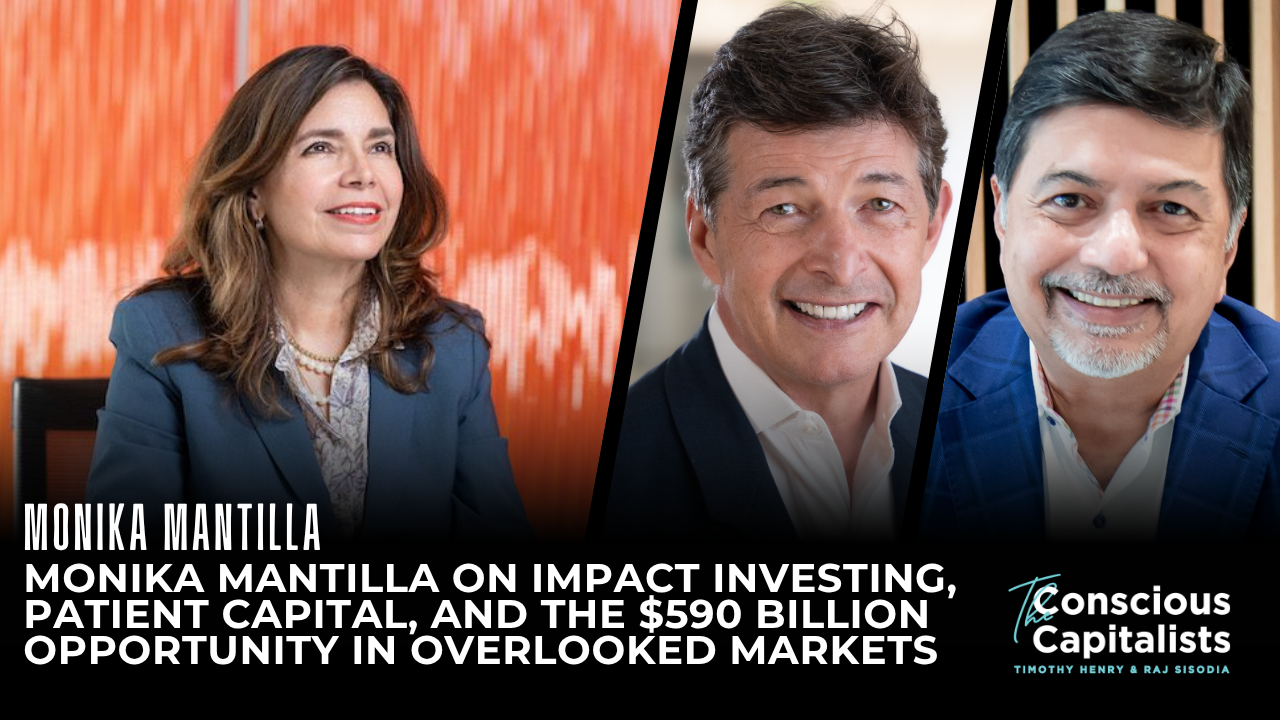
3 lessons from Altura Capital’s Monika Mantilla
For decades, many investors have viewed impact and financial performance as separate conversations. One is about doing good. The other is about generating returns.
Monika Mantilla, CEO & Co-Founder of Altura Capital, argues that’s a false choice.
In her conversation with Timothy Henry and Raj Sisodia on The Conscious Capitalists podcast, she explains why some of the greatest opportunities for value creation exist precisely where many investors have been conditioned not to look.
1. Underserved markets are more than ‘charity’
Altura was built on a simple observation: thousands of strong lower middle market businesses lacked access to institutional capital and strategic support.
Rather than seeing these companies as higher-risk investments, Mantilla saw an inefficient market. Less competition, untapped potential, and entrepreneurs who needed more than capital to reach the next stage of growth.
For CEOs, it’s a reminder that competitive advantage often comes from seeing value where others see complexity.
2. Patient capital is active, not passive.
Patient capital isn’t about waiting longer for returns.
It’s about committing to the work that creates them.
Mantilla describes Altura as an investment platform rather than simply a fund because capital is only one part of the equation. The firm works alongside entrepreneurs on strategy, governance, leadership, financial discipline, market access, and operational improvement.
The lesson extends well beyond investing: sustainable growth is built through capability, not capital alone.
3. Impact is an outcome of building better businesses.
Throughout the conversation, Monika resists framing impact as philanthropy.
Instead, Altura measures outcomes like quality job creation, investment in underserved communities, and expanding opportunity because they believe stronger businesses create stronger economies.
The point isn’t that companies should pursue impact instead of performance.
It’s that businesses designed to create long-term value for employees, customers, communities, and investors are often the ones best positioned to deliver durable financial performance.
Perhaps the biggest takeaway from the conversation is that conscious capitalism isn’t about lowering the bar for returns. It’s about broadening our understanding of where value exists, and having the conviction to invest in it.
If you’d like to dive deeper into the conversation, listen to Monika’s podcast episode here ->