In a business environment defined by constant disruption, most organizations are still designed for stability.
That mismatch is starting to show.
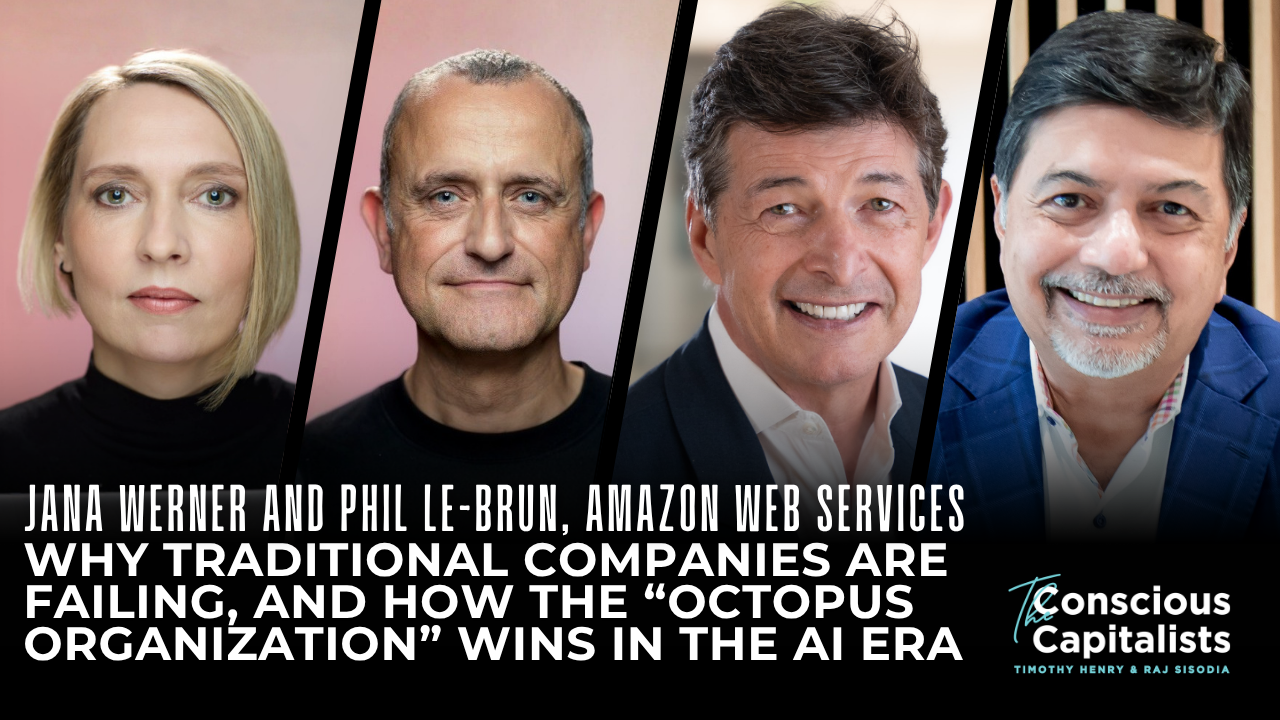
In a recent episode of The Conscious Capitalists podcast, Timothy Henry and Raj Sisodia sat down with Jana Werner and Phil Le-Brun, both Executives in Residence at AWS and co-authors of The Octopus Organization, to explore why traditional models are breaking down, and what leaders need to do differently.
If you’re thinking about how your organization can keep up with the pace of change, here are a few takeaways from their conversation:
1. Most organizations are optimized for control, not adaptation
Many companies still operate on an industrial-era model: centralized decision-making, clear hierarchies, and tightly controlled processes. That worked when environments were predictable. Today, it creates a bottleneck. As Phil explains, the further decisions sit from the front line, the slower and less accurate they become.
True ownership looks different: teams are accountable for outcomes, not just tasks, they have the freedom to decide how to achieve those outcomes, and decisions are made closer to the customer and the work. This shift requires leaders to give up a degree of control, which can feel uncomfortable, especially now, but with it, organizations default to waiting rather than acting.
2. Innovation often fails before it even begins
One of the more striking ideas in the episode is the tendency for organizations to invest in visible progress: labs, pilots, and programs, before validating whether an idea actually works. The metaphor they use is simple: building a pedestal for a talking monkey before knowing whether the monkey can even talk.
This leads to what many executives recognize as “innovation theater”, activity without real outcomes. To avoid it, start with the hardest assumptions, not the most polished solutions; reward learning, not just progress and accept that stopping early can be a sign of discipline, not failure. For leaders, this reframes innovation from a funding problem to a learning problem.
3. Being “ahead of the organization” is a leadership challenge
Jana shares a personal story of presenting a great idea to a leadership team and being completely out of sync with where they were. The feedback she received was blunt: if you’re one step ahead, you’re a visionary. Two steps ahead, and you risk being dismissed because you’re too far away from anyone else.
That doesn’t mean you have to slow down your thinking, just make sure that you’re bringing others along if your ideas are out there.
4. Adaptability comes from distributed intelligence
The “octopus organization” is a metaphor for a system where intelligence is not concentrated at the center. An octopus has a central brain, but much of its processing power sits in its arms, allowing it to react quickly to its environment.
The organizational parallel is that leadership provides clarity, purpose, priorities, and boundaries, while teams at the edges sense, decide, and act. This allows the organization to move faster, learn continuously, and respond to change without waiting for top-down direction.
The bigger picture
This conversation isn’t about replacing hierarchy with chaos. It’s about recognizing that the conditions organizations operate in have fundamentally changed. In a world of continuous uncertainty, advantage doesn’t come from having the best plan. It comes from building a system that can learn faster than competitors, adapt without constant restructuring, and make decisions where reality is closest. For leaders, that means shifting from being the center of decision-making to becoming the architect of how decisions get made.
🎧 Listen to the full conversation with Jana Werner and Phil Le-Brun →