
Observations from My Sight Visit to the Barry-Wehmiller Papersystems (BWPS) Plant in Phillips, WI.
The owner, Bob
Chapman, together with Raj Sisodia, wrote about his people-centered leadership philosophy
in the acclaimed book, Everybody Matters! The Extraordinary Power of Caring
for Your People Like Family. Conscious Capitalism Inc. arranged this sight
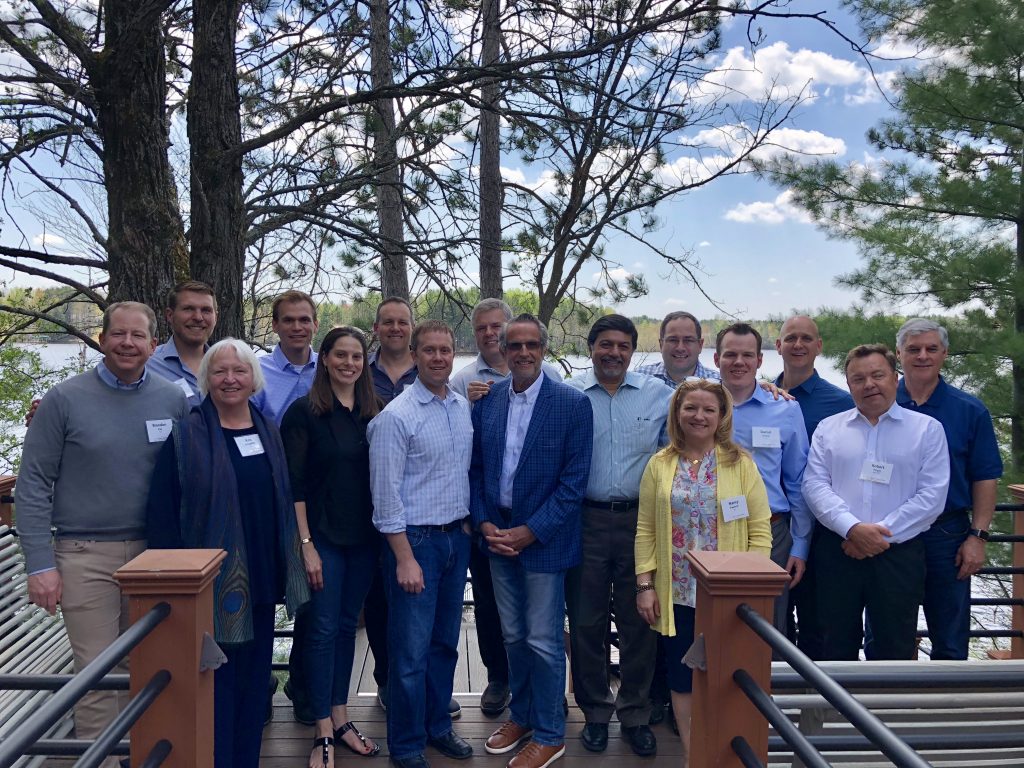
visit for an intimate group 12 visitors – CEOs, presidents, founders, owners of
private and public companies. As an experienced management consultant, I wanted
to see, firsthand, how the Everybody Matters! philosophy had changed the plant’s
culture and impacted the business. It did. In very positive ways.
Falling in love with Jeff.
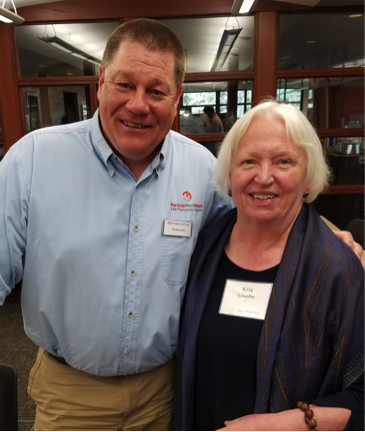
At our arrival dinner, I was seated with Jeff Stilts, one of
the front line team members at the Barry-Wehmiller Papersystems plant. Jeff and
I had a lot in common. We both have small town backgrounds — fishing, making
up our own games, the community feeling. Jeff asked and listened in a way that
bridged any differences in our job levels, education, gender, or geography.
Jeff is talented and common sense smart. I asked him why he
didn’t teach for the Barry-Wehmiller University, which is staffed by BW team
members. He replied that he still had children at home and didn’t want to spend
time away from them traveling. A rock-solid ethic for work-life balance was
important to Jeff and BW respected that.
Jeff certainly would have been an outstanding instructor.
What Jeff did not tell me about himself was that he had significantly influenced
the culture and direction of the company. In 2002, Jeff was a member of the
employee group that wrote the company’s Guiding Principles of Leadership (GPL).
I felt that I had missed the chance to talk with him about how a group of
employees came up with these ideas. It would have been like learning about the
US Constitution from one of its writers. Darn your humility, Jeff.
As dessert was being served, we took turns introducing our
partners to the larger group. I began by saying; “People will talk about us
because I fell in love with Jeff tonight.” Yes, a funny factoid for a small
town. But I was very impressed by Jeff’s innate skills. I wanted everyone to appreciate
Jeff.
Visiting the plant.
Barry-Wehmiller Papersystems makes the machines that make
different types of packaging. Each machine is custom-made. This factory is not
an assembly line; it is an assemblage of craftspeople who work on the various
parts that make up the customized machine. Sheet metal fabrication – Welding – Painting – Building electrical panels.
We got to the plant the next morning. As I checked in to get
my hard-toed shoes and safety glasses, I was asked, “Are you Kris?” Jeff had
already told them about our encounter. But this was not negative small town
gossip. He had passed along a vibe that made me feel welcomed, accepted, and
gladly anticipated. This is what I experienced with all the other BWPS team
members – how well they treat guests and each other.
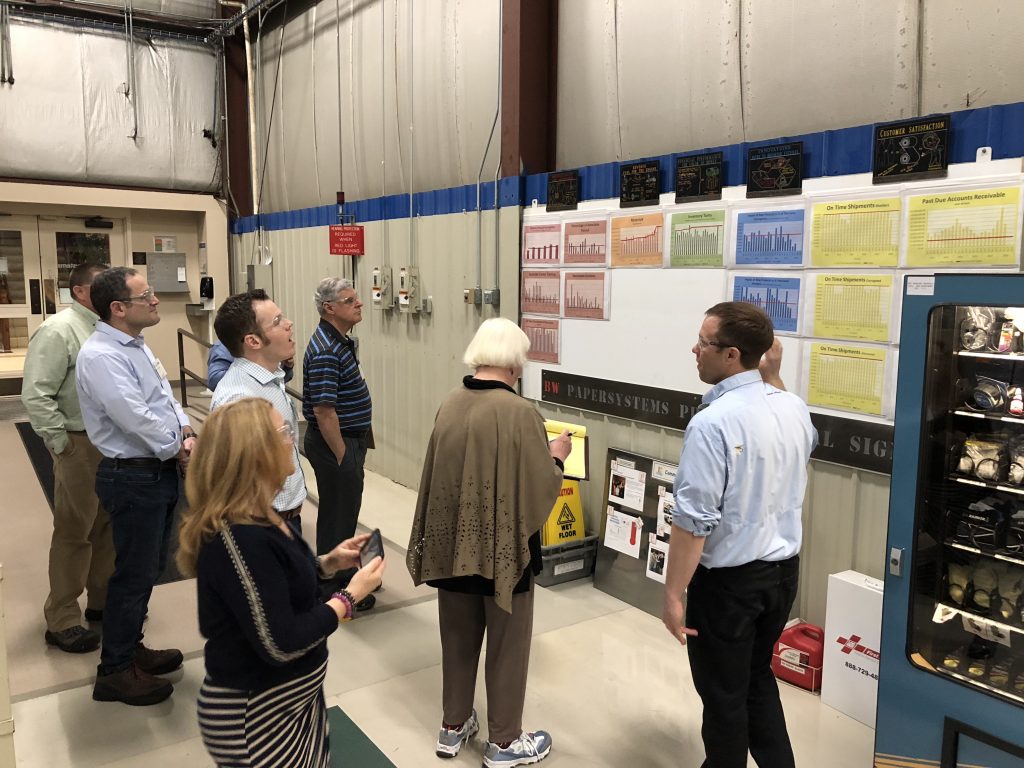
Now on the factory floor, I could see firsthand how this openhearted
harmony worked. Dennis Lemke was our wise guide. Once an engineer and now a VP
at the plant, Dennis could point out how this people-centered culture helped
productivity. He told the story about the job sheets. A job sheet contains the
exact directions to do a job task — the learnings, short-cuts, and cautions
from the expert who has mastered the task. A job sheet would quickly guide
someone to execute the task. But at one point, employees had not written many
job sheets, for fear that someone could take their job.
The BW culture had turned this fear to trust during the 2009
economic downturn. The challenge — how could the business survive a 40% cut in
contracts with not one lay off? BW implemented a self-directed share-the-pain
solution. They designed furloughs that employees could schedule and barter. Once
employees saw that no one was going to lose their job, there was no further reason
for fear. As evidence of the wellspring of goodwill, today there are 17,000 job
sheets. Now, when sales at one plant are slow, they are able to “flex” inside
the building and serve their sister companies. The BW plants are a coordinated
resource to each other. BW plants reduce the need for outside contracting and
expense because they know how to do the work themselves.
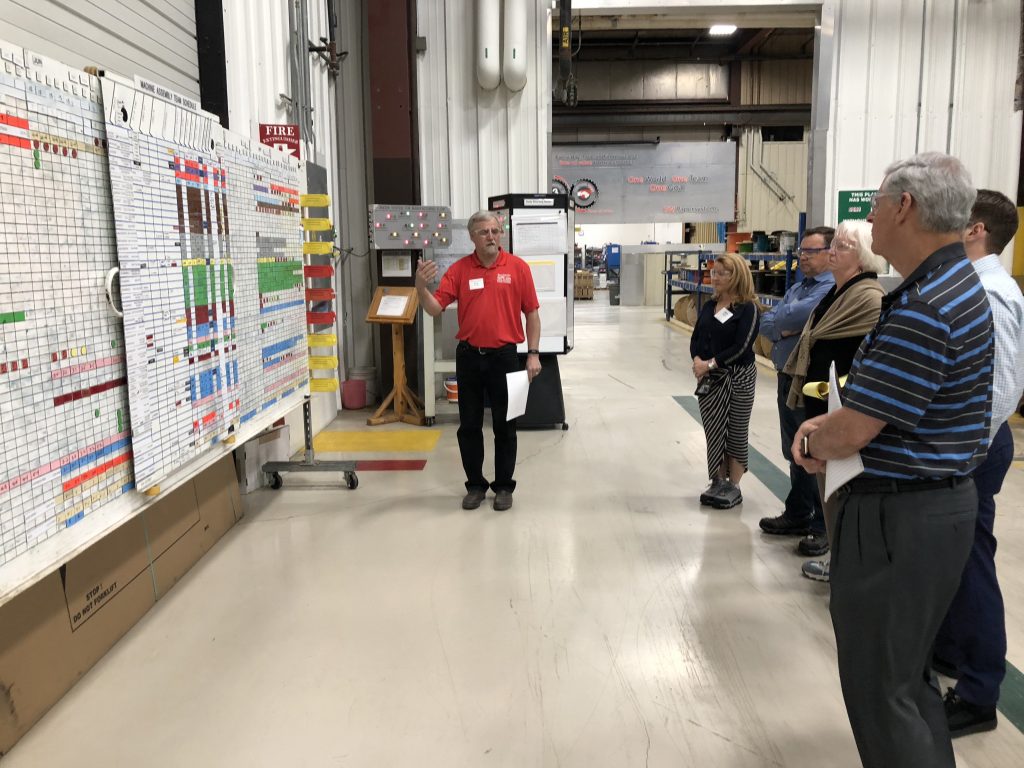
Dennis described the morning Touch Meeting as another
example of daily teamwork. Everyone gathers around the Operations Board. Their
first business is not business. It’s a personal check in about birthdays, kids’
sports, trivia, and laughter. “It’s beautiful to hear how you feel.”
And then these craftspeople review the computer-generated
daily work plan. Assignments are not finished without human input. Team members
swap hours. “I need some help to get this done in 8 hours.” “I have a couple of
hours I can give you.” And together they work out the demands of the day. That
honest harmony leads Barry-Wehmiller team members to achieve their definition
of happiness – “Meaningful work among people we care about.”
Another way that trust shaped the plant is in continuous
improvement. Barry-Wehmiller uses every day to refine their systems. In the
first four months of the year, there have been over 300 improvement
suggestions. That’s an incredible number! At BWPS, lean manufacturing isn’t
just using your head to problem-solve. It’s also using your heart to see how to
wring out frustration from the system. Caring leads to better ideas or as one
person said, “Giving a sh*t.” That prompted a major declaration from one of the
participants. “We implemented Lean Manufacturing first. If I had to do it all
over again, I would have started by building the culture.”
Using Recognition and
Celebration.
In the plant, there is a prominent Recognition Board full of
pictures of awards and parties. It seemed as sincere and spontaneous as a
kitchen refrigerator with many photos of the kids’ recitals and graduations.
Awards are freely given and very cherished. Most awards are from peer
nominations. During one of the team member panels, Jennie Bruner told her
personal story of becoming a “Customer Trust Leader” because many people
encouraged her. “I learned that I had something to offer people.” It’s stunning
to have your co-workers value you.
The plant is full of team members wearing their awards. Badges. Jackets. Pins. They introduce others to guests with this recognition – not what the person does but what they have achieved. Personhood over position –
“We give awards to people who achieve something that is important to our culture, not just to our bottom line.”
Barry-Wehmiller also recognizes and celebrates people simply
to let them know they matter. There were pictures of parties – birthday
parties, company anniversary parties. The factory has a very High Touch, Low
Tech design.
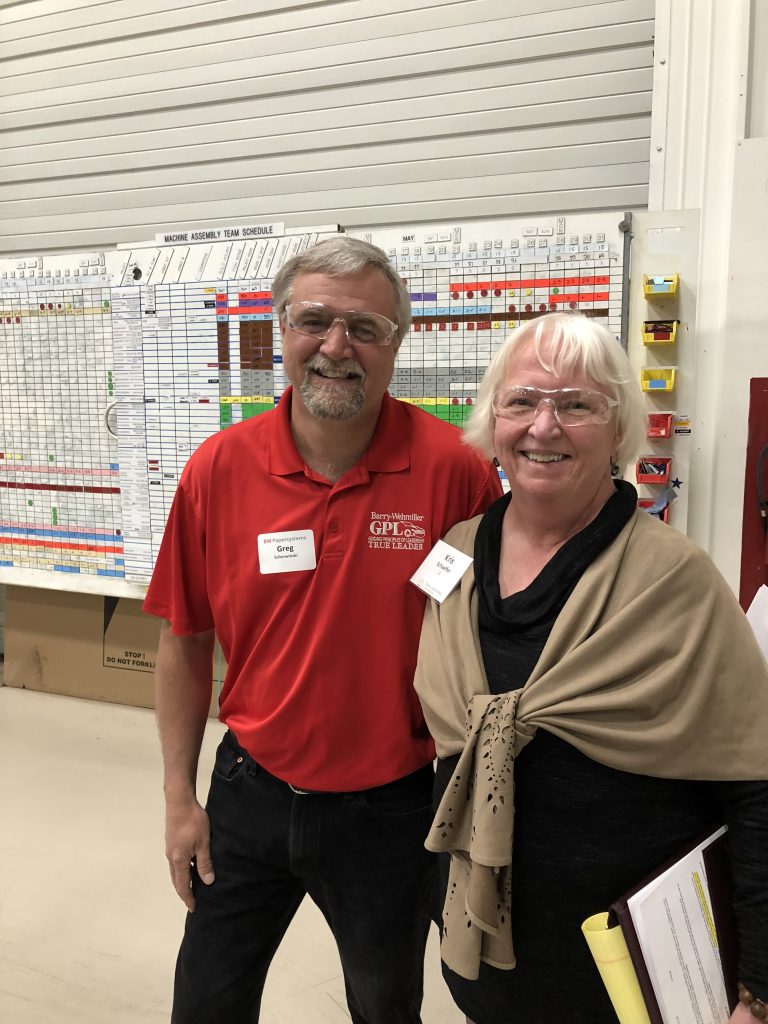
Tracy Williams, who is on the front line of Customer Trust,
was the first winner of the GPL prize – for exemplifying the Guiding Principles
of Leadership. She came to talk to us wearing her red shirt. For her, it was an
extraordinary award. Sometimes, she has to do an unpopular task. After the
sale, if a customer’s machine is down, Tracy may have to take a completed,
working part from a machine in progress and ship it to that customer so they
can get their plant running. As she puts it, it’s better to have havoc with a
BW production schedule than have a customer who is unable to work at all.
Talking about Culture and Leadership.
Now that we had seen that the people-centric culture worked,
we had questions about how to achieve it. Fortunately, the sight visit gave us
more exposure to BW team members, to Bob Chapman and to the other designers of
the company’s culture.
Brian Wellinghoff kicked off the discussion. He had started
as an engineer and moved on to be one of the BWU instructors. He explained Barry-Wehmiller’s
concept of culture. There are four components — Compassion. Integrity.
Consistency. Competence. Which element comes first? Most businesses would start
with Competence. Barry-Wehmiller turns around the sequence. Compassion comes
first. They believe that good people will give you good performance. He
explained that we develop people from the inside out.
Dennis Lemke provided an example of how to apply this model.
At the plant, Dennis used “responsible freedom” on Mike, a project estimator.
His job is to cost out a bid for a multi-million dollar machine. Mike would
spend 40 hours to price a machine yet it would take him only a few seconds to
give an estimate. But he was afraid to be wrong about his estimate. Dennis
said, “We instilled belief in himself so he could do a quick quote. This really
supports our sales department.” This is one example of using trust to build
performance.
Shayne Roberts, a former engineer now in charge of human
resources, reinforced the idea of compassion over competence. He said, “We
never terminate for performance. We do terminate for behavior issues such as
absenteeism or acting inappropriately. If someone is not performing, it’s the
leader’s job to help the team member get up to speed.”
Shayne continued, “Culture is a commitment. This shift in mindset requires patience. Leaders are expected to practice that “courageous patience” along with deep listening and authentic vulnerability.
Shayne explained that it took over six years to build
culture at this plant. “We wanted to build a culture that would last. Now we
have our culture in everything we do — Safety. Leadership. Documents (such as
the Guiding Principles of Leadership). Barry Wehmiller University. Vision of
Service. Wellness.
“Every business has performance measures. We also have a
dashboard of people measures which each leader is responsible for – safety,
wellness, recognition, retention, and training participation.”
All of us agreed that it would take consistent leadership to
embed our own companies with this people-centric culture. We were committed to
try, though somewhat uncertain as to what would be the best path. Together we
developed some ideas: Have cultural dialogues. Look for people to believe and
get them to come along. Realize that it’s a journey; don’t expect quick
results. Convert your cultural aspirations into behavior. There can be multiple
interpretations of words. Actions tend to have “pure meaning.”
Wrapping up the Sight
Visit.
This sight visit was ably designed by Conscious Capitalism, Inc.’s Chief Strategy Officer, Amanda Kathryn Roman and Barry-Wehmiller Leadership Institute’s partner, Brian Wellinghoff. It was a skillful blend of large and small group interactions, panels, and the plant visit. The Barry-Wehmiller way is to allow visitors full, unrestricted access to team members. Nothing is scripted. Everything is real.
About the author, Kris Schaeffer.
During the sight visit, I had an inspiring one on one with
Bob Chapman. “Bob, I flunked retirement twice.” Bob looked directly at me. “You
retire when all you have is work. You don’t retire when your work is a calling.”
What is a calling? Something good for the world; good for me; and ####. What is
my calling? Helping business to be a force for good.
I have worked on organizational culture for forty years.
“Every company has a culture, but few by design.” Culture is not a quick fix
but rather a steady, iterative effort over time. We get there by using a
combination of six “cultural levers” that create systemic, sustained organizational
change.
Today, I work with Conscious Capitalists to convert their vision
and values into operational practices. “Values are exhibited in behaviors.” We
use this model for change: The organization inspects leadership, structure, and
process; while the individual level looks at people, tasks, and rewards. When
these levers are aligned toward the company’s values, the right actions occur.
The Barry-Wehmiller sight visit confirmed this.


